If you walk the perimeter loop at Caumsett on a regular basis, you've probably heard by now that the park got bigger. A press release out of Albany in January announced a 180-acre addition, funded through New York's Environmental Protection Fund, tucked onto land that used to belong to the Seminary of the Immaculate Conception just south of the existing preserve. It sounds like the kind of news that should change your Tuesday morning walk.
It hasn't, at least not yet. The bigger story for anyone who actually uses this park every week is smaller and closer to the ground: a marker system finally going up on trails that never had one, a four-acre patch of meadow getting quietly nursed back from an invasive vine, and one small rule change on the water side of the property that might matter more to you personally than 180 new acres ever will.
The Expansion Everyone Heard About
The new acreage is real. Governor Hochul's office confirmed the state closed on the land using nearly $18 million from the Environmental Protection Fund, adding roughly 12 acres of estuarine and marine wetlands along with bluffs and steep slopes that run down to Lloyd Neck Harbor. That brings Caumsett to about 1,680 acres total, a meaningful jump from the 1,500 or so the park has held for decades.
What the announcement doesn't include is a trail opening date. The land was flagged in the state's Open Space Plan specifically because the bluffs and wetlands are vulnerable to erosion, which is a different kind of priority than passive recreation. Parcels acquired for habitat protection typically go through stabilization and planning before anyone gets a marked path through them. Nothing in state or Foundation materials points to public access opening this year. If you've been waiting to walk the new section, you're waiting on the same timeline as everyone else, and there's no public date yet for when that changes.
What You'll Actually Feel Underfoot This Year
The change you can already see happened on the original 1,500 acres, not the new ones. The Caumsett Foundation, the volunteer group that's been supporting the park since it formed in 1995, rolled out new trail markers across the property this spring.
Anyone who's spent real time here knows why that mattered. The paved three-mile loop with its fitness stations has always been easy to follow. The rest of the property, the horse trails, the hay-field cutoffs, the unmarked woods paths down toward Fresh Pond, has been a different story for years. Regulars have joked for a long time about walking the place hundreds of times and still finding a corner they didn't recognize. The Foundation's own description of the project is blunt about the problem it's solving: helping people find their way around acreage that never had consistent signage.
If your usual route strays past the paved loop, this is the year that got easier. The Perimeter Loop itself, at 5.3 miles with about 337 feet of elevation gain, hasn't changed and doesn't need to. It's the informal network around it that finally has some structure.
The Meadow Doing Quiet Work Behind the Barns
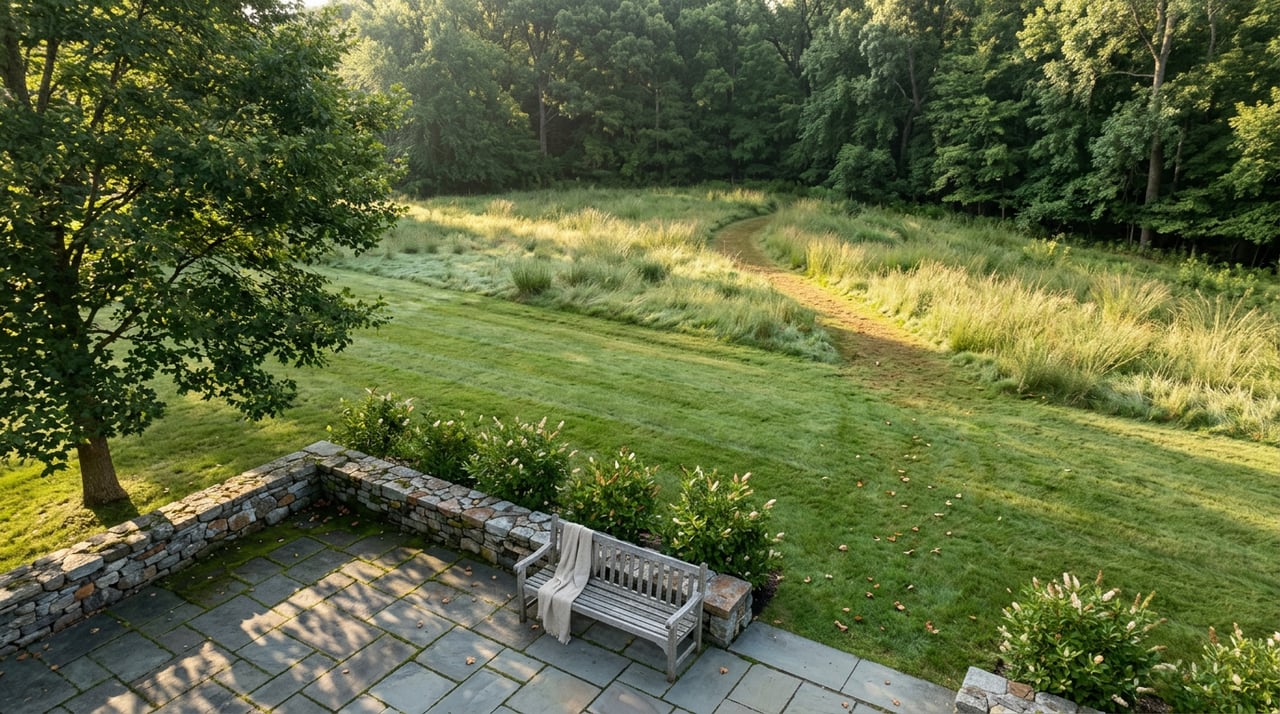
Past the equestrian center, there's a four-acre stretch called Butterfly Hill that's been under active restoration, funded through a New York State DEC grant and run in partnership with the Long Island Invasive Species Management Area. The target is porcelain berry, a woody vine in the grape family that climbs fifteen to twenty feet and smothers everything under it. The reason it's worth clearing goes beyond tidiness. Caumsett holds the only known breeding colony of the Baltimore checkerspot butterfly on Long Island, first documented here in 2009 after just four prior sightings statewide in forty years. Losing the meadow to porcelain berry would mean losing the habitat that colony depends on.
The Foundation's most recent annual appeal lists finishing this restoration as one of its priorities for the year, which means the work is ongoing rather than complete. It's part of a broader invasive fight on the property that also includes hardy kiwi vines, first spotted at Caumsett in 2014 and now the subject of ongoing control efforts, and winter honeysuckle in the understory. None of this shows up on a trail map, but if you've noticed roped sections or a work crew near the hill, that's what's happening.
A Quick Read on What's Live and What's Coming
| Change | Status as of this summer |
|---|---|
| 180-acre expansion (wetlands and bluffs) | Acquired in January 2026; no public trail access date announced |
| New trail markers on original 1,500 acres | Installed this spring, in place now |
| Butterfly Hill invasive removal | Active, listed as an unfinished priority in the Foundation's current appeal |
| Naturalized daffodil planting | Bloomed this past April, will recur annually |
| Fishermans Road access | Restricted to annual permit holders since April 1 |
| Annual Caumsett fishing permits | Sold out |
The Rule Change That Might Matter More For Some of You
If you fish at Caumsett, the more relevant news this year isn't the expansion at all. As of April 1, Fishermans Road and its parking area shifted to annual permit holders only, and those annual permits are sold out for the season. One-day permits are still available for purchase, but they require a valid driver's license, vehicle registration, and proof of enrollment in the state's saltwater fishing registry, no exceptions. It's a narrower door than the one that existed last year, even as the park's total footprint got wider. That's worth knowing before you plan a morning around it.
A Bloom Built for One Anniversary
If you walked past the Manor House lawn this past April, you likely noticed something different. The Foundation planted 100,000 daffodil bulbs, timed intentionally to bloom as the state park system marked its centennial. Most of the planting happened in a single day using a tractor-drawn bulb planter brought in from the Netherlands, a detail that came from Cornell's own flower bulb research program, which consulted on the project. The Foundation did it in homage to Evelyn Field, whose original plantings from the estate era still come up in patches around the grounds a century later.
The bulbs are naturalized, which means they'll keep coming back every spring without replanting. But this year's debut was a specific, engineered moment tied to a specific anniversary, and it already happened. If you missed it, you'll see a version of it again next April, just without the fanfare that came with the hundredth year.
What It Means for a Regular Walk
The pattern across all of this is consistent. The headline number, 180 new acres, is the part of the story that gets a press release and a quote from the governor. The parts that actually touch your weekly routine are quieter: a marker at a fork you used to guess at, a meadow you'll walk around instead of through for a while longer, a permit rule that tightened instead of loosened. None of it is dramatic. All of it is the kind of thing you'd only know if you were paying attention to this specific park in this specific year, which is exactly the point.
Caumsett has always been the kind of place that rewards people who know it well rather than people who just visit it once. This year, that gap widened a little. The Foundation's work, done almost entirely by volunteers and funded through memberships and an annual appeal, is the reason a 105-year-old property still has functioning trail signage and a butterfly colony worth protecting. It's a small, unglamorous kind of stewardship, and it's the same instinct that makes Lloyd Harbor worth paying attention to in the first place.
If you're the kind of neighbor who notices when a trail marker shows up where it never used to be, Scott Van Son pays attention to the same kind of detail, just applied to the homes and streets around Caumsett rather than the meadows. Reach out to schedule a consultation whenever you want to talk shop about this corner of the North Shore.